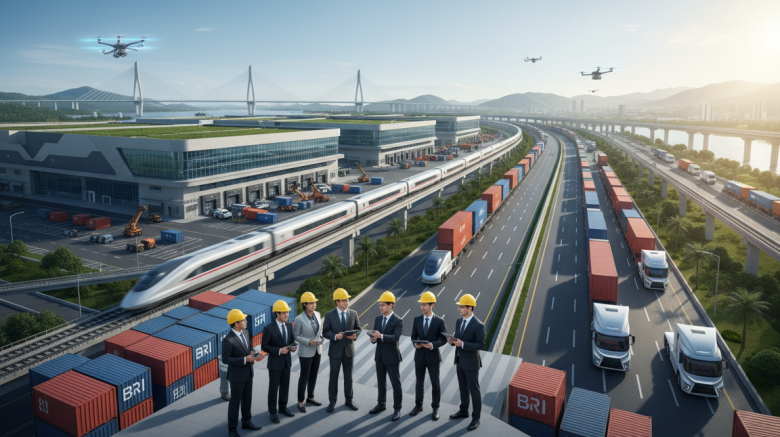
Unexpected fact: By October 2023, this effort reached 151 countries, spanning about $41 trillion in GDP and roughly 5.1 billion people — a scale that reshaped global trade routes. Here, “facilities connectivity” refers to how Beijing financed and built cross-border systems—ports, rail, and digital links—that bind regions together. This introduction sketches what was pursued from 2013 to 2023, what was constructed, and where disputes emerged.
BRI Facilities Connectivity
Expect a brief trend review: first an early megaproject surge, then a turn toward greener, smaller, and more digital initiatives. We will track policy tools, corridor planning, funding patterns, and the main beneficiaries.
This article examines the core tension: infrastructure as a development opportunity versus concerns about debt, governance, and geopolitics. Case studies—CPEC/Gwadar, Indonesia’s high-speed rail, and the Port of Piraeus—ground the analysis.
Belt And Road Facilities Connectivity In Context: What The Belt And Road Initiative Set Out To Do
When Xi Jinping unveiled the New Silk Road in 2013, he recast infrastructure as a tool for shared growth across continents.
Origins And The New Silk Road Frame
Jinping used the Silk Road framing to build legitimacy and attract partner buy-in. The label helped repackage many national plans as one global program.
Scale And Reach As Of October 2023
By October 2023 the belt road initiative touched 151 countries, covered about $41 trillion in combined GDP, and linked roughly 5.1 billion people. This size made the belt road effort a system-level force, not a regional push.
Why “Connectivity” Became The Overarching Goal
Connectivity grouped transport, energy, communications, investment flows, and people movement into one policy storyline. The logic was clear: reduce time and cost for trade, broaden market access, and make cross-border movement more predictable.
| Measure | Figure | Role |
|---|---|---|
| Participating countries | 151 | Program footprint |
| Combined GDP | ~$41 trillion | Economic scale |
| Population reached | About 5.1 billion | Human scale |
China’s government presented the initiative as a platform that uses state finance, SOEs, and diplomacy to deliver projects at scale. Ambition was clear, but formal policy blueprints were needed to turn vision into on-the-ground corridors.
From Vision To Implementation: The Policy Blueprint That Guided BRI Connectivity
The 2015 Action Plan turned a wide policy goal into a clear operating manual for cross-border work. It outlined steps that made planning, finance, and people exchanges practical for a wide range of projects.

The 2015 Action Plan Targets
The plan set four targets: improve intergovernmental communication, align infrastructure plans, build soft infrastructure, and deepen people-to-people ties.
Government-To-Government Coordination
Stronger coordination meant national plans matched at key stages. This reduced political risk and lowered the chance projects stalled after leadership changes.
Aligning Transport And Power
Plan alignment focused on linking transportation systems and power grids across borders. The approach aimed to support industrial zones and urban growth with reliable routes and energy.
Soft Infrastructure And Financial Integration
Soft infrastructure included trade agreements, harmonized standards, faster customs, and financial integration to ease cross-border payments and capital flows.
People-To-People Connections
Education exchanges, joint research, and tourism created the human networks needed to staff and sustain long-term projects.
| Goal Area | Main Step | Expected Outcome |
|---|---|---|
| Coordination | Intergovernmental platforms | Fewer abrupt policy reversals |
| Infrastructure alignment | Transport & power mapping | Connected routes, steady supply |
| Soft infrastructure measures | Trade rules and finance links | Easier cross-border trade |
| People ties | Scholarships & exchanges | Local capacity and trust |
How The Silk Road Economic Belt And The 21st Century Maritime Silk Road Shaped Routes
Two route systems—overland corridors across Eurasia and maritime networks at sea—set the geographic logic for major investments. This dual-track approach guided where money, equipment, and construction teams focused work over the past decade.
Belt and Road Financial Integration
Overland Connections Across Eurasia And Central Asia
Overland corridors prioritized rail, highways, and pipelines that cross Central Asia. These corridors aimed to shorten transit times for exporters and reduce reliance on long sea voyages.
Rail connections across Central Asia became vital as a bridge between producers and markets. Planners frequently integrated towns, terminals, and logistics parks into corridor plans.
Maritime Logistics: Ports, Sea Lanes, And Hinterland Links
The maritime silk road approach broke into three practical parts: port expansion, use of key sea lanes, and inland links that make ports useful. Ports acted as hubs where ships connect to rail and road for last-mile goods movement.
Why Linking Land And Sea Routes Mattered
Linking routes created strategic redundancy. When chokepoints threatened shipping lanes, overland options could divert traffic and keep goods moving.
Reliable route choices improved predictability for shippers. That helps firms plan inventory, cut buffer stocks, and stabilize supply chains.
- The two-route design focused capital on nodes connecting land and sea.
- Corridors turned route maps into investment bundles—ports, terminals, rail links, and customs nodes.
- Real projects required financing, regulation, and operators to work together.
Economic Corridors And Facilities Connectivity: What “Corridor Development” Meant In Practice
Building an economic corridor meant pairing hard works—roads, rail, ports—with softer measures that make places productive.
Corridor development was a package: transport links, logistics nodes, industrial clustering, and policy changes that ease trade. The aim was to convert transit routes into engines of local growth.
Corridors As More Than Infrastructure
Productive integration lays this out clearly. Manufacturing, power supply, and distribution networks were aligned so corridors created jobs and exports rather than just transit fees.
Planners included warehouses, customs hubs, and special zones to capture value close to the route. That helped move goods faster and supported local firms.
Where Corridor Planning Met Local Development
Local strategies, including industrial parks, city-region plans, and land policy, aimed to capture spillovers from corridor projects.
| Aspect Area | Purpose | Risk Factor | Illustration |
|---|---|---|---|
| Transport expansion | Lower travel time | Underuse if demand lags | CPEC links multiple asset types |
| Industrial clusters | Create jobs and exports | Poor zoning can block growth | Special zones near terminals |
| Policy changes | Faster customs, licensing | Reform delays can cut benefits | Local alignment of trade rules |
Over time, the focus shifted from raw construction to utilization, revenue models, and long-run competitiveness. Corridor-scale work is capital-intensive and usually needs state-linked finance and strong political coordination to proceed.
Financing The Connectivity Push: Chinese Banks, Institutions & Competitive Bidding
Cheap, patient capital from Chinese policy banks changed which projects could start and which stalled. That funding model was central to how many large transport and port projects moved forward between 2013 and 2023.
Two policy lenders—China Development Bank (CDB) and the Export-Import Bank of China (EXIM)—received big capital injections. Their bonds trade like government debt and they can tap People’s Bank liquidity. That gave them very low borrowing costs and flexible terms.
The result: Chinese SOEs won many bids by offering attractive finance packages. Between 2013 and 2023, about $1 trillion in investment and construction deals were signed with partner countries. That scale made cheap credit a defining feature of the initiative.
Competitive bidding often came down to finance terms as much as technical offers. Recipient governments sometimes chose faster, lower-conditional loans over longer, conditional multilateral options.
Yet financing didn’t remove implementation risk. Indonesia’s high-speed rail offer won on strong Chinese investment and credit, but land acquisition and licensing delays slowed progress.
Beyond contracts, this model supported industrial policy by keeping SOEs busy through steady overseas pipelines and building execution experience. In turn, finance capacity shaped which sectors dominated early works—transport, energy, and port infrastructure—setting up the next phase of outcomes.
Past Project Patterns: Transportation, Energy, And Ports That Anchored Facilities Connectivity
Early project patterns clustered around three physical pillars: transport routes, power buildouts, and major seaports. That mix made routes practical for trade and connected inland production to overseas markets.
Flagship Corridor Case: A Long Kashgar–Gwadar Link
The China-Pakistan Economic Corridor spans roughly 3,000 kilometers from Kashgar to Gwadar. This project bundles highways, rail, pipelines, and optical cables to give inland China faster maritime access.
Multi-Asset Packages
Corridor bundles combined transportation nodes with power plants and digital links. Putting roads, rail, fiber, and grid work together shows how infrastructure expanded beyond single projects.
Belt and Road People-to-People Bond
Energy-First Investment Patterns
Many corridors prioritized energy first. Large power plants and grid upgrades often preceded industrial parks so factories would have reliable supply.
Ports And Strategic Nodes: Gwadar And Piraeus
Gwadar was leased to a Chinese ports operator until 2059, but rollout lagged—airport and free-zone timelines slipped and usable acreage remained small in 2023. That slowed cargo flows and muted local benefits.
By contrast, COSCO’s majority stake at Piraeus gave operators direct control and a foothold into Europe’s logistics network. The two examples show how ownership and execution shaped real gains.
When energy, transport, and port work align, corridors cut costs and speed goods movement; when they don’t, utilization and benefits lag.
Economic And Trade Effects: How Connectivity Initiatives Influenced Growth And Integration
Shorter transit routes and smoother border processes made new markets accessible for many exporters. Reduced shipping time lowered logistics costs and improved delivery predictability.
Companies could lower inventory buffers. That raised the appeal of exporting manufactured goods to farther markets and supported trade growth at regional scale.
How Moving Goods Faster Changed Trade
Lower transport costs and steady schedules raised the volume of traded goods on several corridors. Faster delivery made perishable and time-sensitive products more viable for export.
Measured effects included shorter lead times, cheaper freight per unit, and higher shipment frequency for certain routes.
Financial Integration: RMB Use & Bond Issuance
Issuing RMB bonds and encouraging local currency use reduced currency friction. That helped buyers and lenders avoid expensive conversions and created deeper capital links.
RMB-denominated instruments also made Chinese investments easier to price and finance across borders.
| Route | Mechanism | Likely Effect | Example |
|---|---|---|---|
| Transport improvements | Shorter routes and better terminals | Lower freight costs, quicker delivery | Rail and port packages |
| RMB bonds | Local issuance and currency swaps | Lower exchange risk, deeper markets | RMB bond programs |
| SOE export of capacity | Overcapacity deployed abroad | More project supply, lower pricing | Steel & construction exports |
Domestic Drivers And Regional Reshaping
Behind the projects were domestic aims: keeping state firms busy, exporting excess steel and cement, and deploying large national savings overseas.
Over time, rising links can shift regional trade patterns and increase some countries’ economic reliance on a major partner. That reshaping can boost productivity while also increasing political leverage.
Partner countries may gain jobs, improved logistics, and growth if projects match local needs and governance is strong. However, benefits depend on sound project choice, transparency, and complementary reforms.
Scale creates both upside and risk. The same forces that raise trade and financial integration also magnify concerns about debt, governance, and underperforming projects—issues explored next.
Constraints And Controversies That Shaped Outcomes In The Past Decade
A mix of financial strain, governance gaps, and execution bottlenecks shaped how many projects performed across partner countries. These limits forced policy shifts and changed public perceptions of large-scale investment programs.
Debt Stress And Cautionary Cases
Sri Lanka and Zambia became cautionary examples. Debt strain and repayment concerns shifted political debate and led some governments to renegotiate or halt deals.
“Repayment stress can reshape public opinion and force governments to rethink long-term commitments.”
Governance And Corruption Risks
Weak oversight increased value-for-money concerns. Low 2022 CPI scores—Turkmenistan (19), Pakistan (27), Sri Lanka (36)—help explain recurring worries about transparency and fraud.
Execution Bottlenecks And Underperformance
Common delays came from land acquisition, licensing, procurement disputes, and cost overruns. Indonesia’s high-speed rail missed early targets for those reasons.
Kenya’s railway stopped short of the Uganda border, and a parliamentary review found rail freight could cost more than road transport. Incomplete networks lower returns and spark political backlash.
| Constraint | Example | Effect | Policy Response |
|---|---|---|---|
| Debt sustainability | Sri Lanka, Zambia | Renegotiation, public protests | Loan terms review |
| Governance risks | Low CPI scores | Value-for-money doubts | Transparency measures |
| Execution delays | Indonesia rail | Cost overruns; slow utilization | Tighter procurement rules |
| Underuse | Kenya railway shortfall | Reduced economic returns | Project reappraisal |
Geopolitics And A Pandemic-Era Slowdown
Geopolitical skepticism from the U.S. and some allies reduced high-level participation and nudged certain countries away from large deals. Italy signaled shifting interest, for example.
Investment flows also dropped: outbound construction and investment in 2022 were $68.3B, down from $122.5B in 2018. That ~44% fall showed a clear momentum shift.
Taken together, these constraints forced adaptation and set the stage for a 2023 pivot toward greener, digital, and integrity-focused cooperation.
How BRI Connectivity Began Evolving By 2023: From Megaprojects To Green And Digital Links
By 2023, the playbook had clearly shifted from headline megaprojects to targeted, lower-risk efforts. The October white paper framed this as a move toward smaller projects emphasizing sustainability, tech collaboration, and cross-border digital trade.
Signals From The 2023 White Paper And Forum Priorities
The 2023 white paper and the Third Forum emphasized a multidimensional network rather than one-off giants. Xi listed commitments emphasizing green development, science and technology cooperation, and stronger institutions.
New Emphasis: Green Development, Science & Technology, E-Commerce
Green development responds to environmental critiques and tighter financing. Smaller renewable projects and upgrade work can be approved and funded faster, with clearer permits and reduced social backlash.
Digital and e-commerce links expand the initiative’s scope. Data flows, platforms, and cross-border trade systems now sit alongside ports and rails as core parts of future integration.
Institution-Building And Integrity-Based Cooperation
Greater focus on integrity and institution building aims to manage debt and transparency risks. Stronger procurement rules, compliance checks, and joint oversight reduce political and financial friction for partners and lenders.
AI Governance And Shaping Rules
The Global Initiative for Artificial Intelligence Governance signals a shift toward setting norms, not only building assets. Rule-making in AI and standards work can shape influence across the 21st century as much as physical projects once did.
Implication: This shift changes how partner countries measure success. Future influence will come from greener projects, digital platforms, and shared rules—tools that are harder to quantify but may be more durable.
Conclusion
Summary: Years of rapid projects reshaped routes and cut trade frictions, but outcomes differed by country. Success depended on clear economics, strong governance, and timely delivery.
Over the decade, the Belt and Road approach moved from large hard-infrastructure builds to a more selective, reputation-aware agenda. By 2023, the initiative emphasized green development, digital links, and stronger institutions.
Core mechanisms include route architecture (land and sea), corridor development logic, and financing driven by policy lenders and state firms. Major controversies—debt stress, corruption risks, execution delays, and geopolitical pushback—shaped the shift.
Watch next: green project pipelines, e-commerce platforms, and AI governance. For U.S. audiences, this evolution matters for standards, supply-chain routing, port influence, and the competitive landscape for development finance.